
We are halfway through 2026, and I find myself in a mid-year pause where I like to take stock — of the work we are doing together, of the patterns I am seeing across the practice, and of the questions that keep landing in my inbox. Thank you, as always, for trusting me with the deeper version of your story. That is not something I take for granted.
This month I want to spend some time talking about a single number that some of you know about, but all of you will gain benefit in tracking: your heart rate variability, or HRV. Some of you watch it daily on your Oura or Apple Watch. I have been surprised at how many of you have never heard of it. Either way, it is one of the most useful windows we have into your global health and how well your body is recovering from the life you are asking it to live — a signal rooted in your nervous system but reaching into nearly every system downstream.
What HRV Actually Measures
Your heart does not beat like a metronome. Even when your resting pulse is 60, those beats are not spaced one full second apart — they vary by milliseconds, and that variation is the signal we care about. HRV is the beat-to-beat fluctuation in time between heartbeats
At its simplest, HRV tells us which mode your nervous system is living in — the calm, restorative rest-and-digest state where your body repairs and recovers, or the activated survival state where it is bracing, defending, and running on alert. Most of us spend far more time in survival than we realize, and HRV is one of the few tools that quietly shows us that.
A higher number means your body is adaptable — it can shift gears, handle stress, and bounce back. A lower number means your body is stuck in a more “on alert” state, the way you feel when you have not slept well, are fighting something off, or have been running on fumes for too long.
What HRV is really measuring is the balance between two sides of your nervous system: the one that revs you up (fight-or-flight) and the one that calms you down (rest-and-digest). When the calming side is strong and engaged, your HRV is higher. When your body is stuck in stress mode — from poor sleep, illness, hard training, alcohol, emotional load, inflammation, or chronic infection — your HRV drops.
It is a quiet, honest readout of where your body actually is, regardless of how you feel that day.
Why WE Need to Pay Attention to IT
HRV is not a diagnosis. It is a trend signal. Over years, it tracks with cardiovascular risk, inflammation, metabolic health, and overall mortality. Over weeks, it shows me how well you are tolerating training, stress, perimenopause shifts, a new medication, mold exposure, or an acute infection. Over days, it tells us whether your nervous system got real recovery from last night’s sleep.
What I am almost never interested in is one number on one morning. Single readings move with hydration, alcohol the night before, sleep position, even when you took the reading. The story is in the pattern.
A Loose Reframe of Reference
Before we talk numbers, one important clarification. There are two different HRV measurements floating around, and they are not on the same scale:
-
RMSSD — what your Oura, Apple Watch, Whoop, or Garmin is showing you (or a proprietary score built from it). It is a short-window measurement that reflects vagal tone.
-
SDNN — a 24-hour clinical measurement, usually from a Holter monitor. This is the one the cardiology literature refers to when it says HRV below 50 ms is associated with higher mortality, and below 100 ms is already elevated risk. Those thresholds are real and important — but they do not translate directly to the number on your wrist.
So when you read that “HRV under 50 is bad,” that is true — for SDNN on a 24-hour recording, but not necessarily for the RMSSD on your Oura ring in the morning.
With that distinction in mind, here is a rough way to interpret your wearable RMSSD in midlife.
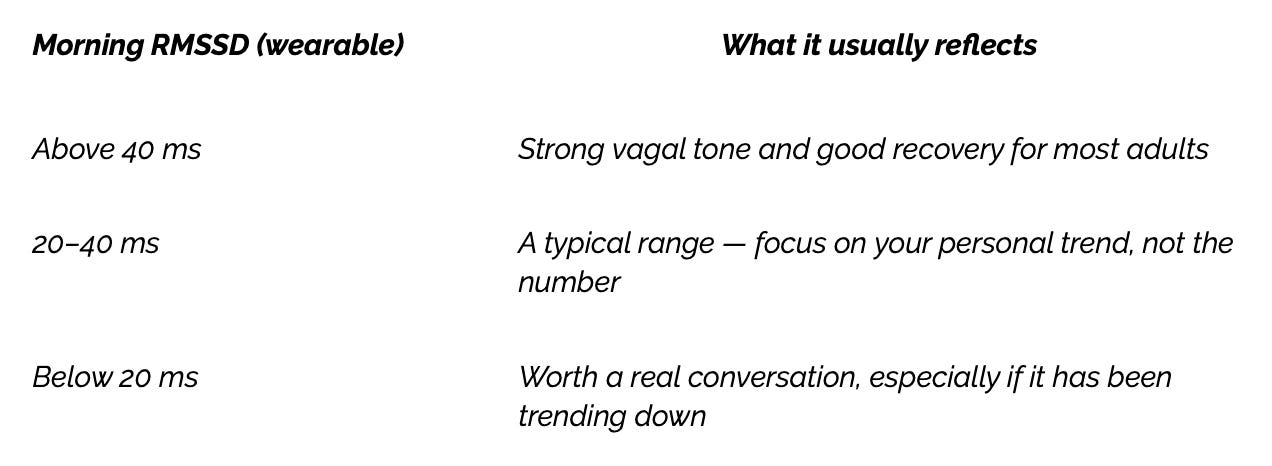
The single most important thing to understand: the absolute number matters far less than your personal trend. A healthy person can sit at 25 ms and a healthy person can sit at 90 ms. I generally want to see your numbers in the 40+, along with knowing if your number is stable, climbing, or quietly drifting down — and what that is telling us about everything upstream of it.
What Tends to Move HRV - In Either Direction
Things that lower it:
-
alcohol (even one drink)
-
short or fragmented sleep
-
late or heavy meals
-
overtraining
-
untreated sleep apnea
-
dehydration
-
viral illness
-
chronic infection or mold exposure
-
unmanaged stress
-
inflammation from any source
Things that raise it over time:
-
consistent sleep
-
Zone 2 cardio
-
slow nasal breathing
-
cold exposure used thoughtfully
-
time outdoors
-
social connection
-
treating the underlying drivers we are already working on together
-
quietly but reliably — therapy and trauma work
How We'll Use It in Your Care
If you wear an Oura, Apple Watch, Whoop, or Garmin, we will look at trends rather than individual numbers — a 30-day or 90-day view tells me far more than one day reading. If you are in our wearables monitoring pilot, this is exactly the kind of data I am looking at between visits. And if your HRV has been drifting down for weeks while we have been chasing a particular symptom, that is almost always pointing me toward the nervous system as part of the answer, not just the lab on the page.
As always — we use the tool when it helps fill in a piece of the puzzle. It is information, not dogma.
The Heart of It
The goal is not to chase a higher number on a wearable. The goal is to build a body and a nervous system that can meet life — stress, illness, joy, hard seasons — and recover. HRV is simply one of the more honest mirrors we have for whether that is actually happening.
Where this becomes genuinely useful is in your day-to-day choices. Once you know your personal baseline, your HRV can guide the small decisions that add up to either recovery or accumulating wear and tear. A few rough guideposts I share with patients:
-
A drop of around 10% or more below your baseline, lasting more than a day or two, is your body asking for something easier. That is the morning to swap a hard workout for a walk, a yoga class, or a true active rest day. Pushing through a low HRV reading is almost always a withdrawal, not a deposit.
-
A single low day — after a glass of wine, a late dinner, a poor night of sleep, or a hard training session — is information, not alarm. Note it, give your body what it needs (a dry day, more fluids, maybe a nap), and move on.
-
A trend that drifts down over a week or two is the one I really want to know about. That is usually pointing to something upstream: stress, an unresolved infection, hormonal shifts, poor sleep architecture, or simply too much life without enough recovery.
-
Plan ahead with it. If you have a demanding stretch coming — an overseas trip across time zones, a heavy work week — look at where your HRV has been in the days leading up. The day before that trip is not the time to cram in HIIT or a max-effort session. Swap it for resistance training or a long Zone 2 instead. You will arrive with a nervous system that has something left in the tank, rather than one already running on fumes before the jet lag even hits. The data lets you make that choice on purpose, instead of by accident.
-
Honor the boring inputs. The things that move HRV the most are the things we already know matter: consistent sleep, slow nasal breathing, time outdoors, Zone 2 movement, real meals, real connection, and protecting your nervous system from the inputs that keep it in survival mode -mindless social media, late-night news, constant notifications, the email that did not need to be answered at 10 p.m., and the low hum of background stress most of us have stopped even noticing. None of these feel like much in the moment. All of them register on your HRV.
This is what I mean when I say HRV is not just a longevity metric — it is a daily feedback loop that helps you make the next right choice for your body, in real time. Over months and years, those small choices are what build the kind of resilience that actually protects healthspan.
Protecting your healthspan in service of your lifespan — so that living longer also means living better.
With gratitude,
Dr. Lechner
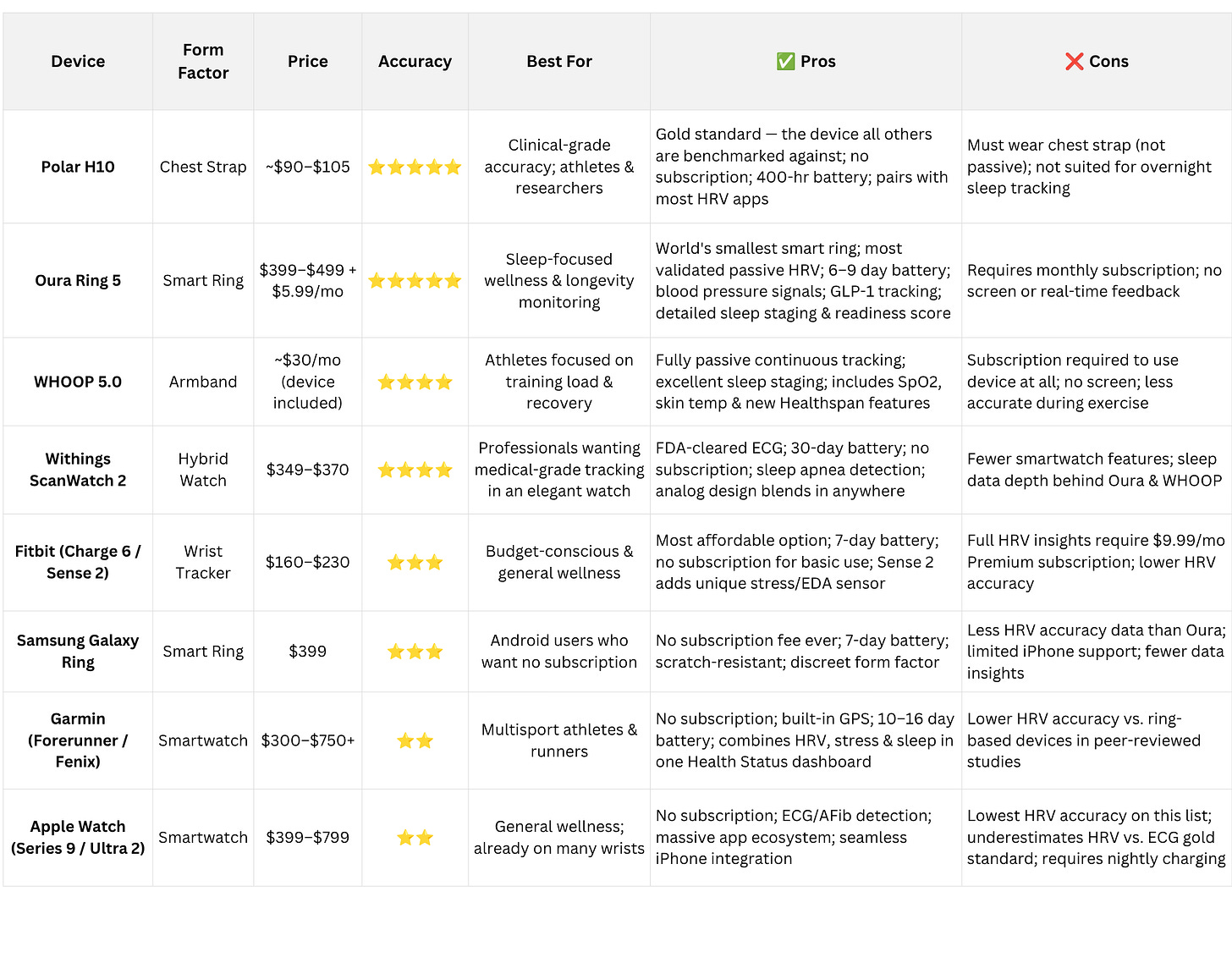
HRV Tracking Devices at a Glance
Knowing your HRV is only half the equation — tracking it consistently is what turns a single data point into a meaningful health trend. The good news is that there are more options than ever for monitoring your HRV at home, ranging from clinical-grade chest straps to sleek smart rings you wear around the clock. The table below compares eight of the most popular devices currently on the market across the dimensions that matter most: accuracy, price, form factor, and real-world pros and cons.
Devices are ranked by HRV measurement accuracy (highest first), then by price within the same accuracy tier. Accuracy ratings are based on peer-reviewed validation studies comparing each device to ECG gold-standard measurements.